
With the next funding deadline fast approaching on January 30, Congressional appropriators have found a way to maintain critical energy innovation funding—though not without trade-offs.
This week, House and Senate appropriators released text of a bicameral, bipartisan bill to fund parts of the government, including the FY 2026 Energy and Water Development appropriations bill which funds the Department of Energy. Funding for critical energy research and development programs survived relatively intact, avoiding the drastic cuts proposed in the President’s budget request, with language included that aims to protect Congressional funded programs and DOE operations. But Congress achieved these funding levels by shifting funds from Infrastructure Investment and Jobs Act (IIJA) investments.
The Numbers Tell the Story
Even taking the topline numbers at face value, most DOE energy and innovation programs will see cuts compared to last year. The Office of Energy Efficiency and Renewable Energy (EERE) and the Office of Fossil Energy (FE) will take the biggest hits, while only the Office of Science and Office of Nuclear Energy will see modest increases, with additional dollars allocated for the Advanced Reactor Demonstration Program and for grid components also coming from IIJA funds.
Here’s how’s FY 2026 funding compares to what Clean Tomorrow recommend in our Re-Energizing America report to keep the U.S. globally competitive:
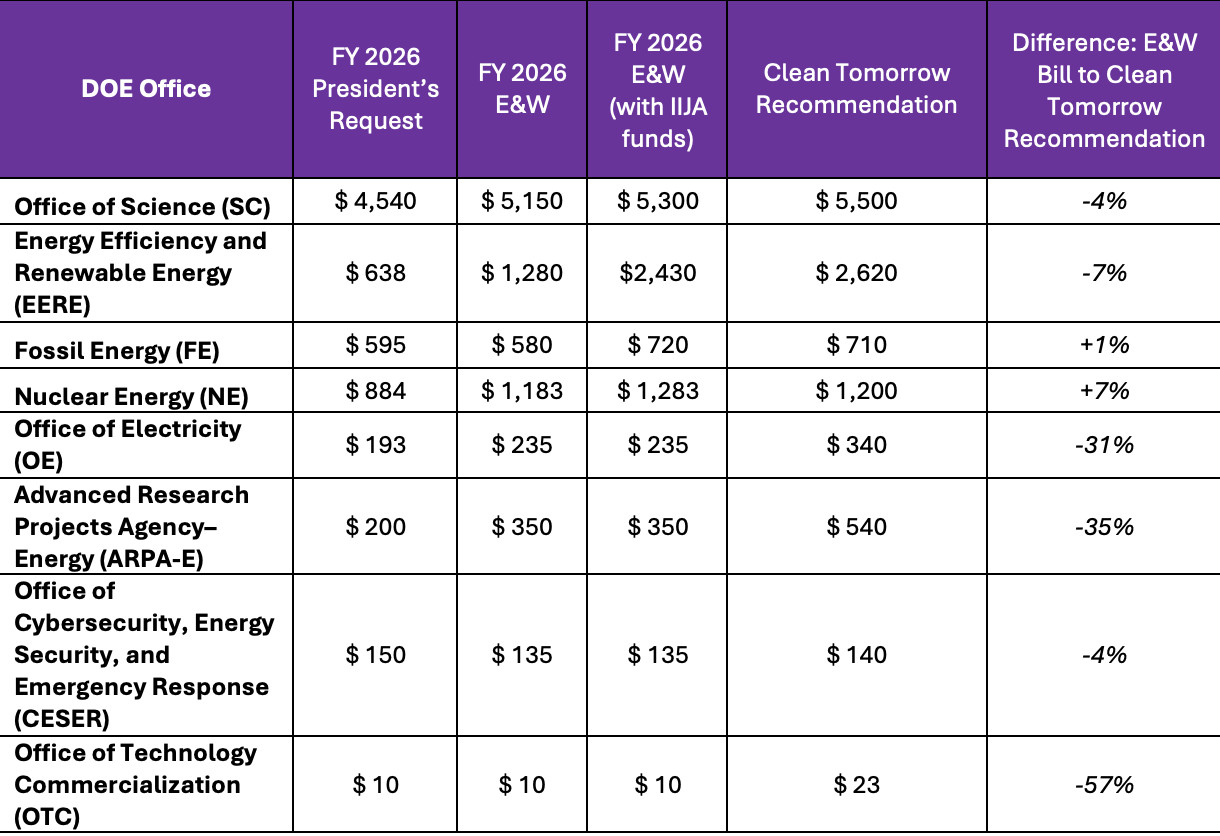
Table: All figures in millions. Funding is for energy research, development, and demonstration (RD&D) as defined in Clean Tomorrow’s Re-Energizing America report.[1]
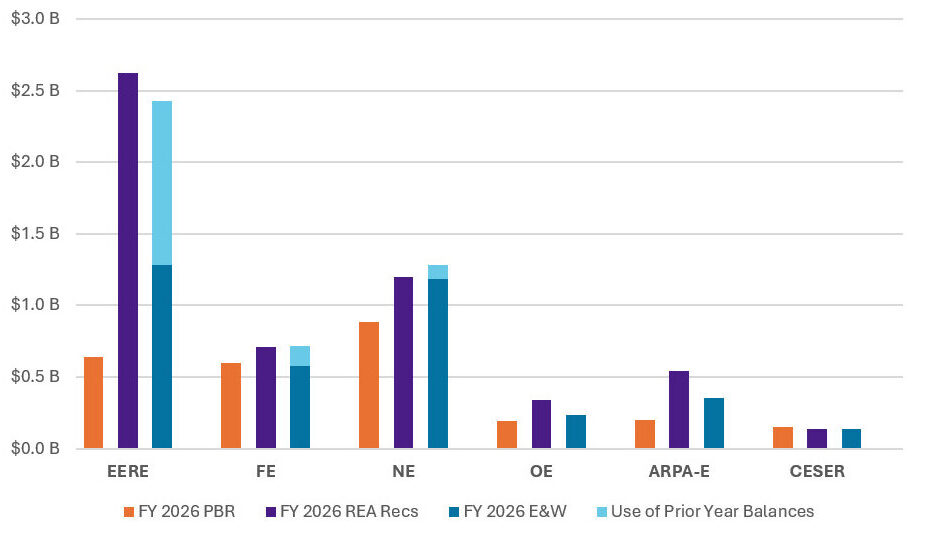
Figure: FY 2026 Energy RD&D funding in the President’s Budget Request (PBR) and the E&W bill, compared to Re-Energizing America recommendations for select DOE offices.[1]
What’s Being Reallocated
To close the funding gap, appropriators are using unobligated IIJA dollars from programs designed to prove that emerging clean energy technologies work in the real world:
- Civil Nuclear Credit Program
- Carbon Dioxide Transportation Infrastructure (CIFIA)
- Direct Air Capture Hubs
- Carbon Capture Demonstrations and Pilots
- Energy Efficiency and Renewable Energy Programs
These aren’t small side projects. These are programs that were supposed to help the U.S. lead in nuclear power, carbon management infrastructure, and breakthrough clean energy technologies. While existing demonstration projects of advanced nuclear reactors will continue to move forward, others are less certain.
The Path Forward
With this shifting of funds, EERE, FE, and NE funding levels approach what Clean Tomorrow recommended for FY 2026 to remain globally competitive and sustain strategic investment in the next generation of energy technologies. While this is preferable to the significant cuts the offices were set to see under the President’s budget request, it is not a long-term strategy for adequately funding the Department.
Next year Congress will face the same choice: commit to robust annual appropriations for DOE energy programs or watch U.S. energy innovation fall behind international competitors who are making strategic, sustained investments in their energy future.
If the United States is serious about leading the world in energy technology and maintaining its competitive advantage, temporary funding fixes cannot become the standard.
Congress must chart a path toward sustained, predictable funding growth for energy innovation—the kind of strategic investment that secured America’s leadership in previous technological revolutions.
[1] Re-Energizing America: Reclaiming American Leadership in Energy Innovation, Clean Tomorrow, November 2025.
Clean Tomorrow’s Re-Energizing America report recommends a strategic pathway to $25 billion in annual DOE RD&D funding by 2030. Learn more here.